
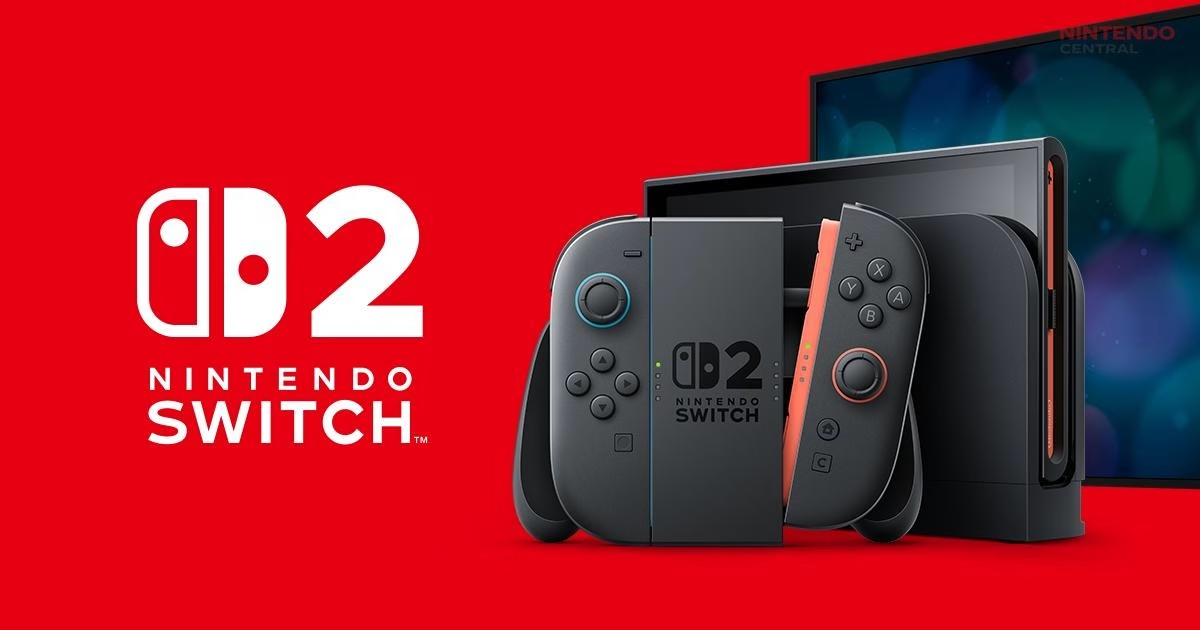
The Summer Game Fest has become a defining moment for the Nintendo Switch 2, with this year’s reveals pointing toward a major shift in how the industry views Nintendo’s latest hardware. One year after launch, the console is no longer seen as a secondary platform for scaled-down ports. Instead, it is now firmly part of the day-one release strategy for several high-profile AAA games.
This change reflects growing confidence from major publishers, many of whom are now treating the Switch 2 as a viable alternative alongside PlayStation and Xbox. The momentum seen during Summer Game Fest suggests that Nintendo’s new console is entering a much stronger phase than its predecessor ever achieved at a similar point in its lifecycle.
AAA Games Arrive on Switch 2 Without Delay
One of the clearest signs of this shift is the number of major titles confirmed for simultaneous release across all platforms. Upcoming projects like Resident Evil Veronica and Final Fantasy VII Revelation are set to launch on Switch 2 on the same day as their PlayStation and Xbox counterparts.
This level of parity has historically been rare for Nintendo platforms. In previous generations, large-scale third-party games were often delayed, downgraded, or skipped entirely due to hardware limitations. The Switch 2 appears to be changing that narrative.
Industry observers have noted that this alignment across platforms signals confidence in the console’s performance capabilities. As one analysis from a Summer Game Fest industry roundup highlights,
“parity with other platforms is finally becoming realistic,”
pointing to a broader industry shift in how Nintendo hardware is positioned.
The growing list of supported titles goes beyond just a handful of flagship releases. Several major publishers are actively bringing their biggest franchises to the platform, including Capcom and Square Enix, both of which showcased multiple projects during the event.
In addition to new titles, a wave of ports is also arriving on Switch 2 at a faster pace than seen with the original Switch. Games like Dragon’s Dogma 2, Lies of P, Stellar Blade, and Rise of the Tomb Raider are part of a growing library that continues to expand across genres.
This rapid influx of content indicates that developers are increasingly confident in the platform’s ability to handle modern game design demands. It also reflects a shift in strategy, where Nintendo is no longer treated as an afterthought in multi-platform development.
Nintendo Commits Fully to the New Platform
While third-party support is crucial, Nintendo’s own strategy is equally important in shaping the console’s trajectory. The company has made it clear that its focus is now firmly on the Switch 2, with a steady stream of first-party releases planned throughout 2026.
This lineup includes a mix of core franchises and accessible titles aimed at broader audiences. Notably, Nintendo has chosen to make certain mass-market games exclusive to the Switch 2 rather than releasing them on the original Switch, signaling a decisive transition between generations.
This approach is designed to accelerate adoption of the new hardware. By concentrating development efforts on a single platform, Nintendo is ensuring a consistent flow of content that showcases the system’s capabilities.