
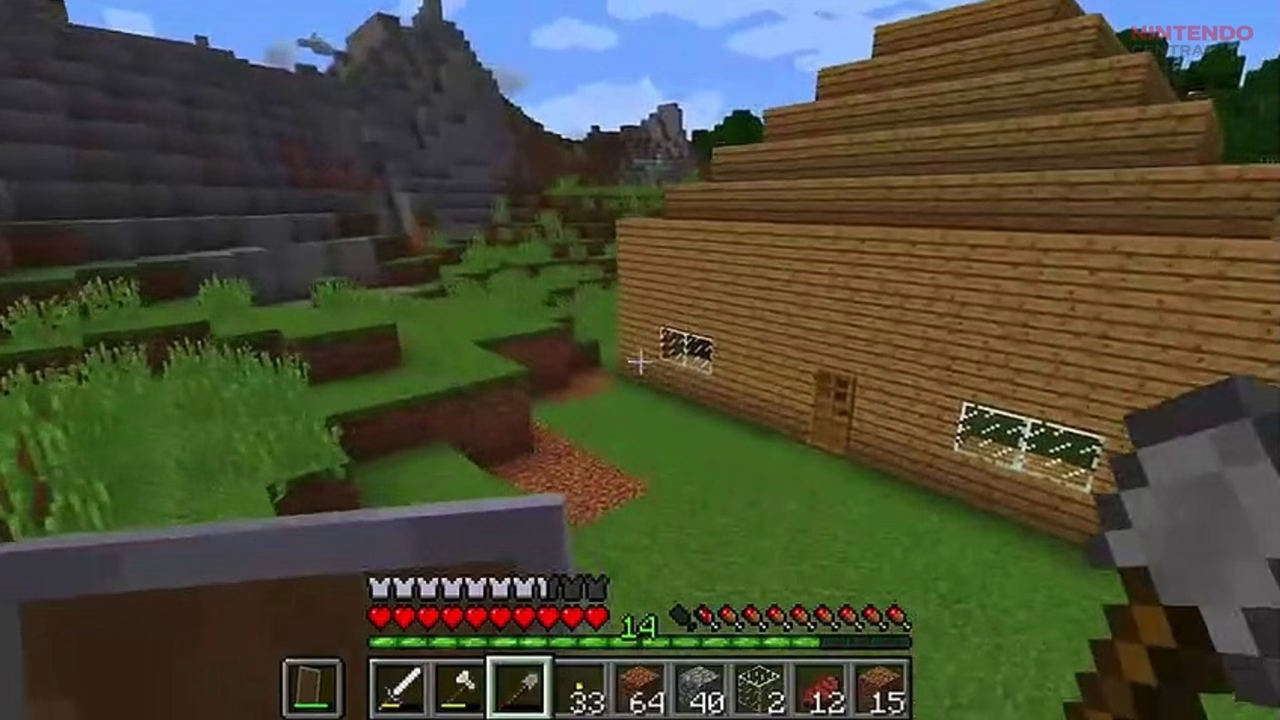
At a time when conversations about cities often focus on problems, a group of students in New York City is offering something different. Through a unique competition called Battle of the Boroughs, public school students are using Minecraft to rethink how their city could function better. What starts as a classroom activity quickly evolves into something much bigger, blending creativity, civic awareness, and practical problem-solving.
The tournament brings together teams from across the city, asking them to design solutions for real-world issues. Instead of abstract assignments, students tackle questions that directly affect their communities, from access to food to transportation gaps. The result is a learning experience that feels both personal and impactful.
Turning Gameplay Into Real-World Problem Solving
Battle of the Boroughs is not just about building impressive digital structures. The competition challenges students to think critically about urban life and propose meaningful improvements. Using Minecraft Education, participants design neighborhoods, infrastructure, and public spaces that reflect their vision of a better city.
Some teams imagine a future where fresh, healthy food is available to everyone, while others focus on renewable energy or improved public transit. Ideas like extending subway lines to underserved areas or redesigning public spaces are explored through detailed builds. These projects show how gaming can become a powerful tool for understanding complex civic systems.
Teachers play an important role in guiding this process. Many encourage students to draw inspiration from their own surroundings, asking them to rethink familiar spaces. Whether it is redesigning a school building or reimagining a local park, the goal is to connect creativity with lived experience.
The competition unfolds over several stages, starting with early submissions and leading up to citywide finals held during the NYC Video Game Festival. As students progress, they refine both their designs and their ability to present them.
By the time they reach the semifinals and finals, participants are no longer just building. They are explaining their ideas in front of judges and audiences, defending their design choices, and communicating complex concepts clearly. This combination of technical and presentation skills is a key part of what makes the program so effective.
In 2025, the competition expanded its scope by asking students to work on iconic locations like Governors Island. This pushed teams beyond their immediate neighborhoods and encouraged them to think about the city as a whole. The shift added another layer of challenge while also broadening their perspective.
Building Confidence Alongside Creativity
One of the most noticeable outcomes of the program is the confidence it builds in students. For many participants, especially those still developing language skills, presenting their work publicly can be a major milestone. Teachers have observed students grow from hesitant speakers into confident presenters over the course of the competition.
This transformation is particularly meaningful in diverse classrooms where students come from different linguistic and cultural backgrounds. The ability to stand in front of an audience and explain a complex idea is not just an academic achievement; it is a life skill.
The collaborative nature of the competition also plays a big role. Students work in teams, dividing responsibilities and learning how to communicate effectively. They combine coding, design, and storytelling to bring their ideas to life, creating an environment where different strengths can shine.