Location accuracy is one of the most important systems in Pokémon GO, and in 2026, players still frequently encounter small inconsistencies in how their position is tracked. One of the most noticeable examples of this is GPS drift, where a trainer’s avatar appears to move slightly on its own even though the player is not physically walking. This effect is not intentional gameplay design but instead comes from limitations and fluctuations in mobile location technology.
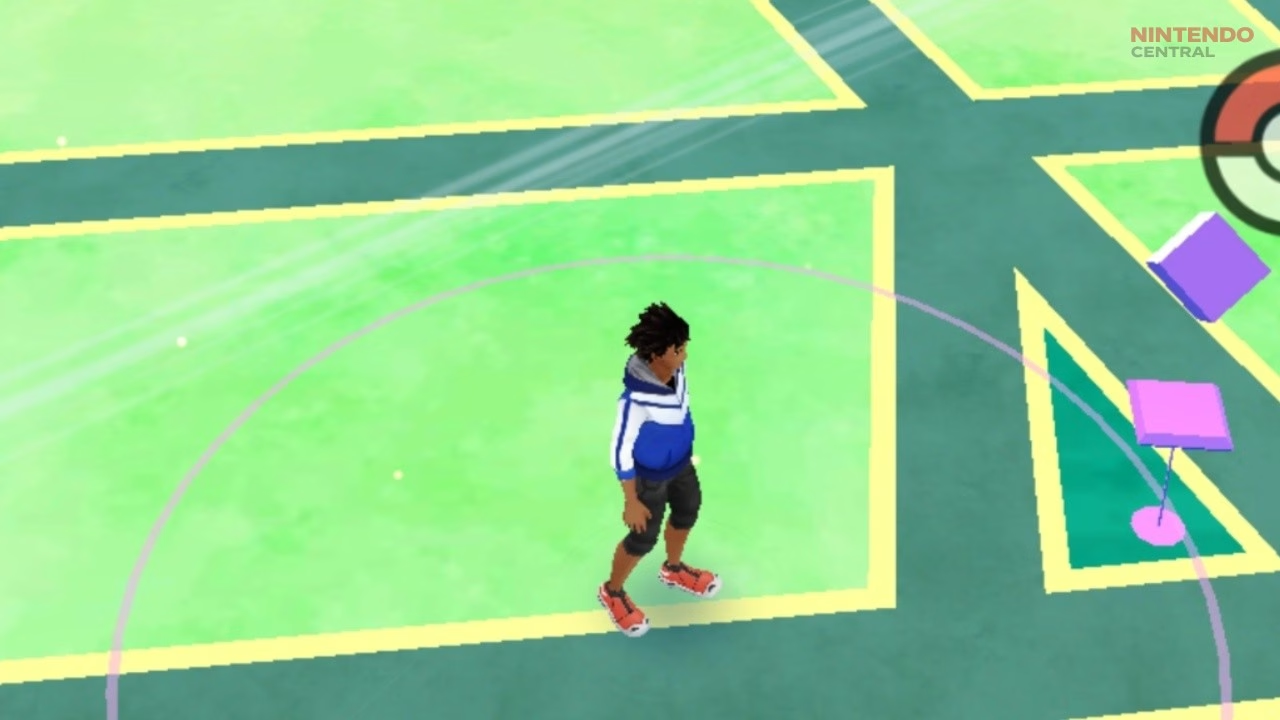
GPS drift in Pokémon GO refers to the in-game character moving without the player physically walking. It is caused by inconsistencies in GPS accuracy rather than deliberate input from the player. While it can sometimes feel like the game is allowing passive movement, it is actually the result of signal fluctuations between satellites, Wi-Fi networks, and device sensors. In most cases, it is harmless, but in certain situations, it can overlap with behaviors that the game’s anti-cheat system monitors closely.
GPS Drift Mechanism, Causes, Gameplay Effects, and Anti-Cheat Concerns Explained
GPS drift happens when a smartphone cannot lock onto a perfectly stable location. Instead of staying fixed, the device reports small variations in position. Pokémon GO translates these variations into slight movement of the avatar on the map.
The most common causes in 2026 include weak satellite signal reception, obstruction from tall buildings, and indoor environments where GPS signals are partially blocked. Urban areas with dense infrastructure are especially prone to this issue because signals bounce off surfaces before reaching the device, creating inaccurate readings.
Modern smartphones also combine GPS data with Wi-Fi and Bluetooth scanning to improve accuracy. When these systems provide conflicting information or lose consistency, the resulting location estimate becomes less stable. This instability is what produces visible drift in the game.

Although unintended, GPS drift can occasionally benefit players. Some users notice that their avatar slowly moves enough to contribute to egg hatching distance, buddy candy progress, or nearby PokéStop access. This makes it mildly useful for players who are not actively walking but still want limited progression.
Stationary players often experience drift more frequently indoors, which can lead to a small but steady accumulation of distance-based rewards. However, this is not consistent or reliable. The movement is random and depends entirely on environmental signal conditions rather than player control.
Because of this unpredictability, GPS drift should not be treated as a planned strategy. It may assist progression in rare cases, but it is not designed to replace actual movement in gameplay.
Niantic actively monitors player movement patterns to ensure fair gameplay. While natural GPS drift is generally tolerated, unusual or repetitive long-distance movement can raise flags in the system.
The main concern is distinguishing between normal signal fluctuations and behavior that resembles location spoofing. If movement appears too fast, too precise, or too consistent across large distances, the system may interpret it as manipulated location data.
Community observations and ongoing system updates suggest that Niantic continues to refine detection methods. This means even unintentional drift in unstable environments could occasionally be misinterpreted if it resembles unnatural travel patterns.
GPS Drift Effects, Environmental Causes, Detection, and Gameplay Impact in Pokémon GO
GPS drift can create mixed gameplay experiences. In some cases, it provides minor convenience by allowing passive distance gain or accidental access to nearby game elements. However, it can also cause disruptions.
Players may experience sudden jumps in avatar position, inaccurate map placement, or difficulty interacting with nearby Pokémon, PokéStops, and gyms. These inconsistencies can interfere with timing-based gameplay, such as raids or gym battles.
Because Pokémon GO depends on precise location tracking, even small errors can affect gameplay reliability. When drift becomes too frequent, it may reduce the stability of in-game interactions.
Several external factors influence how often GPS drift occurs. Indoor environments typically increase drift due to blocked satellite signals. Urban environments with tall structures can also distort or reflect signals, leading to inaccurate positioning.
Device quality plays a significant role as well. Older phones or devices with weaker GPS hardware tend to experience more noticeable drift. Meanwhile, newer devices with improved location processing systems may reduce or stabilize it.
Background apps that use location services can also contribute to inconsistencies by introducing competing data sources. This can increase the likelihood of unstable positioning in Pokémon GO.
It is important to separate natural GPS drift from intentional location manipulation. Natural drift happens randomly due to environmental limitations and is not controlled by the player. In contrast, spoofing involves artificially altering location data using external tools.
Niantic treats these behaviors very differently. Natural drift is generally accepted as a technical limitation of GPS technology, while spoofing is strictly prohibited and can lead to severe penalties.
The difficulty lies in detection accuracy. If movement appears too extreme or unnatural, even accidental drift can sometimes be misclassified as suspicious activity.
When suspicious activity is detected, Pokémon GO may apply enforcement actions. A soft ban is the most common initial response. It temporarily restricts gameplay functions such as catching Pokémon, spinning PokéStops, or interacting with gyms. These restrictions usually last a short period and serve as a warning.
A hard ban is far more serious and results in permanent account termination. This typically occurs when repeated violations or clear cheating behavior are detected.
The system is designed to escalate gradually. Players are usually given warnings before permanent penalties are applied, allowing time to adjust behavior and avoid further issues.
In 2026, GPS drift remains a natural side effect of mobile location systems rather than an intended feature of Pokémon GO. While it can occasionally provide minor passive benefits, it is inconsistent and not reliable for planned gameplay use.
Its presence reflects the broader challenge of combining real-world positioning with augmented reality mechanics. Because the game depends heavily on accurate location tracking, even small fluctuations can noticeably affect gameplay.
GPS drift should be understood as a technical limitation rather than a gameplay tool. Recognizing how and why it happens helps players better interpret in-game movement while avoiding unnecessary risks linked to misread or unstable location data.